
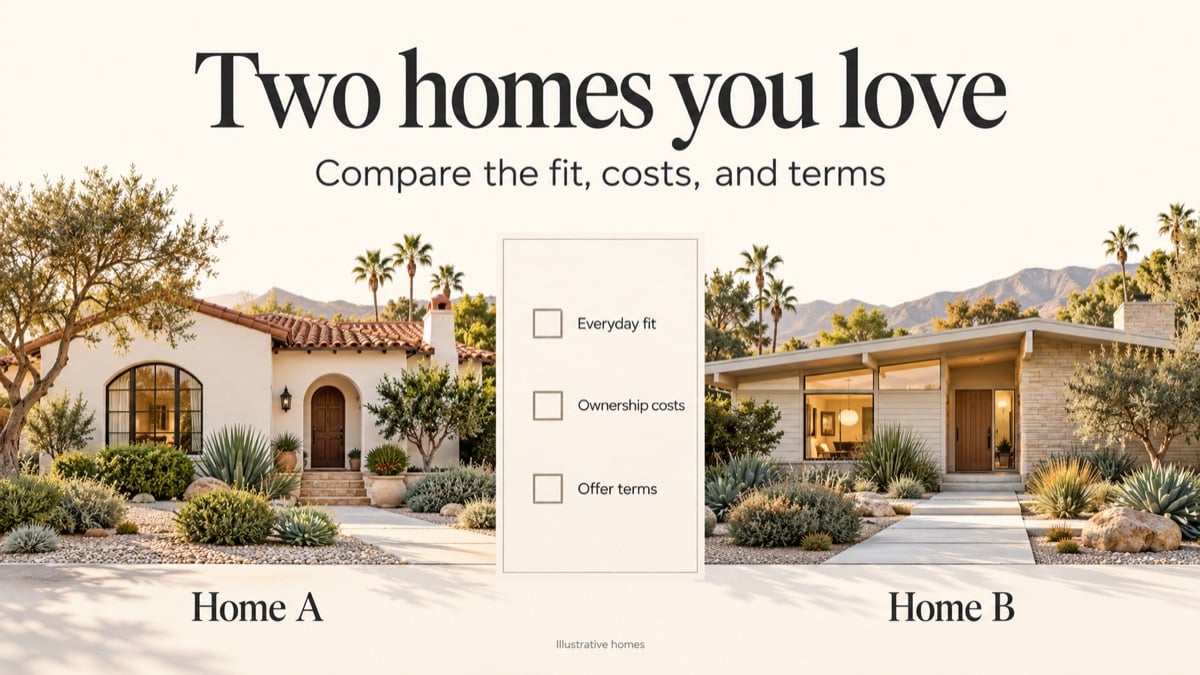
You found two homes you would be happy to own. One has the kitchen you pictured. The other feels easier to live in. Both are within reach, and every new conversation seems to change your mind. I would start by comparing five things: everyday fit, the full ownership cost, the questions still unanswered, the offer terms, and the seller's response. Together, they give you a more useful picture than another round of listing photos. My 3-3-3 home-search guide helps narrow the search. This is the next decision: choosing between two serious finalists in Los Angeles or the San Fernando Valley.
1. Compare the life you would live in each home
Picture an ordinary Tuesday. Where do you work? Where will you park? Does the layout work when someone needs quiet and someone else is cooking or watching television? If you commute across the Valley or over the hill, test the route at the time you actually travel. Revisit the street when possible. Notice traffic, outdoor noise, natural light, and how the home feels beyond the open house. Write down your three nonnegotiables before scoring either property. A bonus room is useful only if it solves a real need. A beautiful finish should not outweigh a daily compromise you already know will bother you.
2. Compare the full cost of ownership
Two similar asking prices can lead to different budgets. Ask your lender to compare each home using consistent financing assumptions. Include principal and interest, property taxes, insurance, any mortgage insurance, and HOA dues where applicable. Then account for utilities, maintenance, and planned work.
Separate recurring costs from immediate work
Keep monthly expenses in one column and cash needed for closing, moving, and near-term repairs in another. A lower purchase price may leave room for improvements, but only if the work, timing, and cash required suit you. Get a property-specific insurance quote and confirm coverage availability with an insurance professional. For repairs, replace guesses with qualified estimates as information becomes available. Mark unknown costs as unknown. A blank cell should never quietly become zero.
3. Identify what you still need to verify
Before calling the homes equal, list the unanswered questions for each. Review the available disclosures and inspection information. Depending on the property, questions might involve the roof, drainage, electrical system, sewer line, additions, or HOA documents. In LA and the Valley, a converted garage or extra room may look like the perfect solution. If that space is central to your decision, verify its permitted status and intended use with the appropriate professionals and records. Do not give an unverified feature the same weight as a confirmed one. I want to know which unknown could change your decision, who can answer it, and when. This turns a vague concern into a practical next step.
4. Compare the offers you would actually make
Asking price is the starting point. Look at relevant comparable sales, the property's condition, and the terms you are prepared to offer. Set a comfortable price limit for each home before a counteroffer creates pressure. Then compare timing and terms. Does the proposed closing date fit your financing and move? Is the seller asking for possession after closing? What inspection or other contingencies are important to your situation? A concession has value only if it addresses something you need and works within the transaction. Keep your preferences clear. You might accept a different closing date, but not a monthly cost that strains your budget. Knowing that distinction makes the next conversation more productive.
5. Use the seller response to clarify your choice
If both homes genuinely work, coordinated offers on both may be an option. Before proceeding, we need a transaction-specific plan for timing, possible overlapping acceptances, and the commitments you are prepared to make. Review the actual contracts, contingencies, and deadlines, with broker or legal guidance where needed. Do not assume you can withdraw or cancel simply because you prefer the other home. The responses can then help separate your options. One seller may accept workable terms. Another may counter beyond your comfort level. A slow response is information, but it does not tell you everything about a seller's intentions. Bring each response back to your priorities. A quick yes does not fix a poor fit. A counteroffer does not automatically eliminate a home you prefer. You still make the decision.
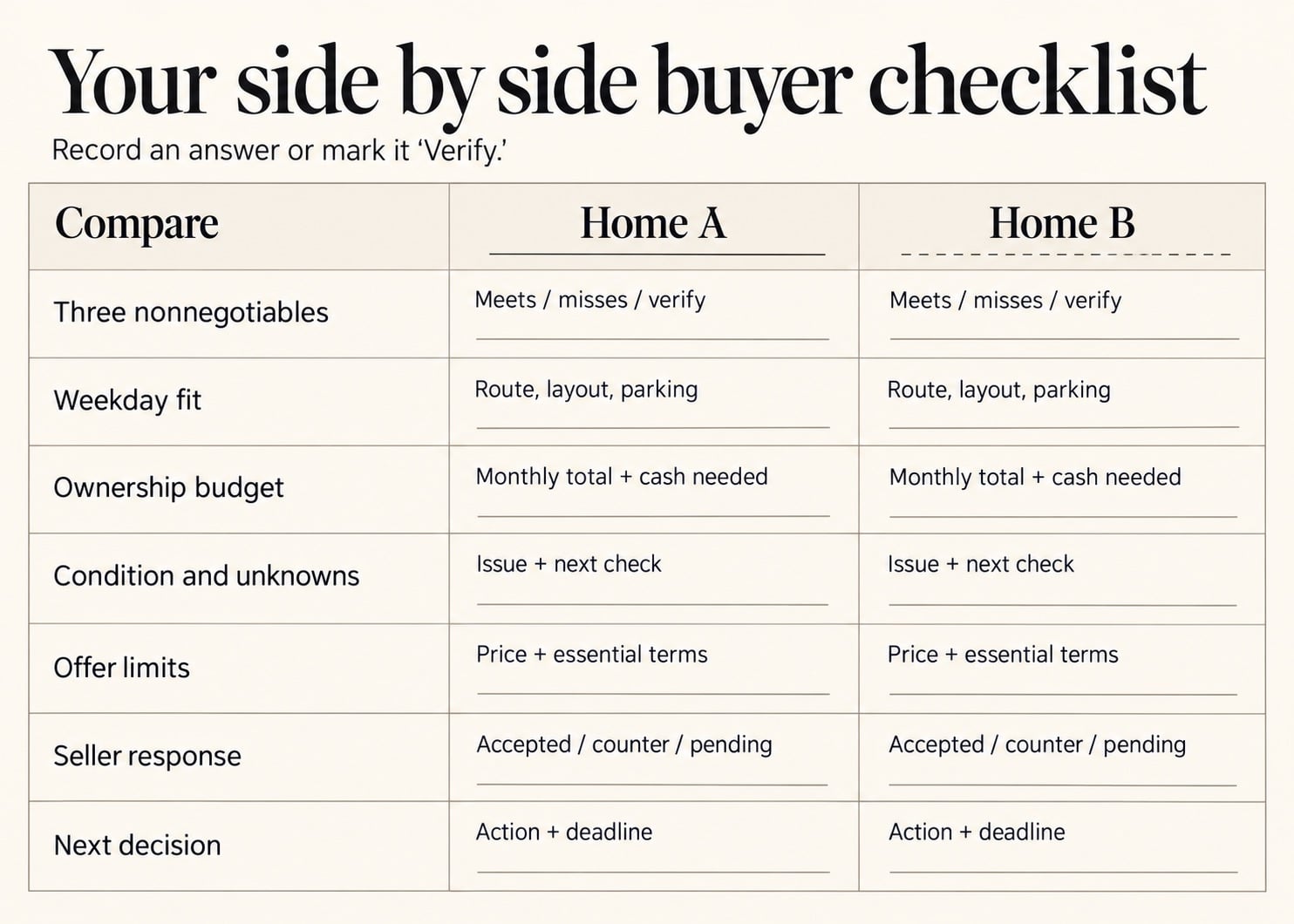
Your side by side buyer checklist
Use the same questions for both homes. Record an answer or mark it 'Verify.' Update the comparison when new information or a counteroffer arrives.
| Compare | Home A | Home B |
|---|---|---|
| Three nonnegotiables | Meets / misses / verify | Meets / misses / verify |
| Weekday fit | Route, layout, parking | Route, layout, parking |
| Ownership budget | Monthly total + cash needed | Monthly total + cash needed |
| Condition and unknowns | Issue + next check | Issue + next check |
| Offer limits | Price + essential terms | Price + essential terms |
| Seller response | Accepted / counter / pending | Accepted / counter / pending |
| Next decision | Action + deadline | Action + deadline |
A hypothetical comparison
Imagine two homes that both meet a buyer's needs. Home A has the preferred layout and needs more immediate work. Home B is easier to move into, but its commute is less convenient. After reviewing costs and planning their offer strategy, the buyer receives two different responses. Home A's seller counters within the buyer's established limit and accepts a workable closing date. Home B's seller asks for a price the buyer is uncomfortable paying. Home A now deserves a closer look, provided the repair estimates and remaining checks support the budget. The seller's response helped clarify the choice; the buyer's priorities supplied the standard. This is an illustration, not a client story or a prediction.
Make the comparison before the commitment
You do not need to find a home with no compromises. You need to understand which compromises you can comfortably live with. If you are choosing between two homes, send me both listings through my contact page or call 818-355-2700. We can compare the fit, costs, and terms. For the broader process, start with my Los Angeles and San Fernando Valley buyer guide. Hooman Morvarid REALTOR® | COMPASS 818-355-2700 | DRE #02192053
Helpful homebuying resources
Check out this article next